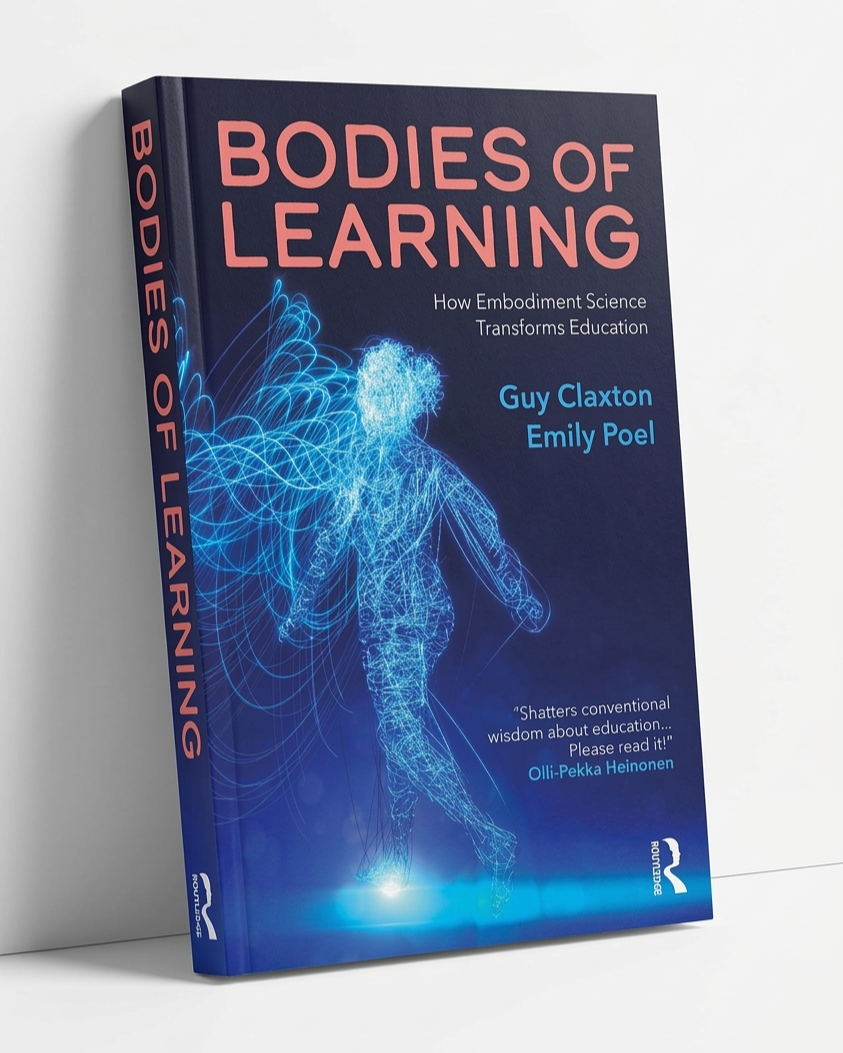
“Shatters conventional wisdom about education… Please read it!”
Olli-Pekka Heinonen, Director-General, International Baccalaureate Organisation
by Guy Claxton & Emily Poel
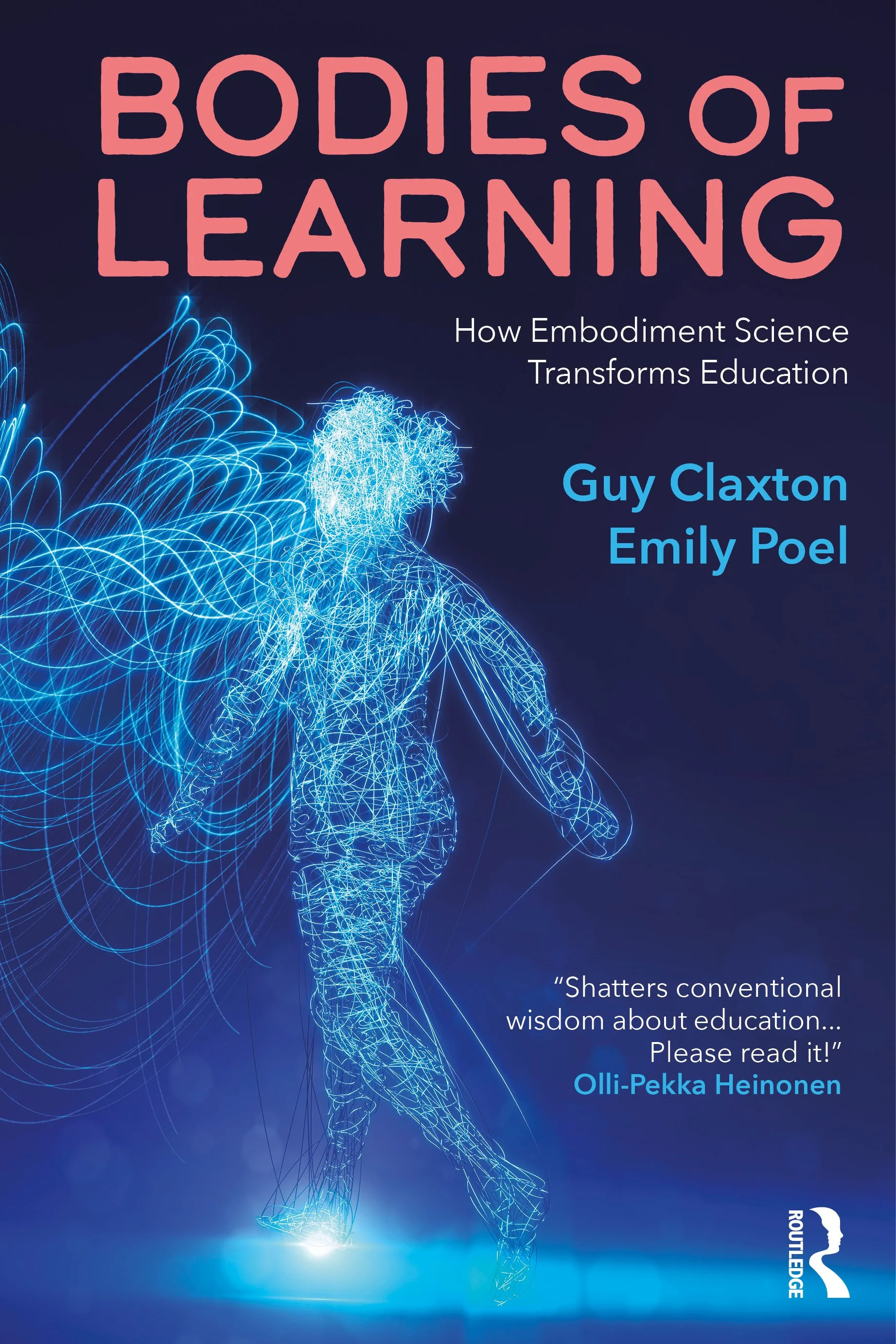
In Bodies of Learning, Guy and Emily challenge the assumption that mind and body are separate, revealing the interconnectedness of the ‘bodymind’ and drawing on research in embodied cognition to rethink intelligence, learning and teaching. They show how learning is intuitive, emotional and physical, challenging the long-standing priority given to intellectual understanding over physical and emotional intelligence, and offer practical strategies for creating classrooms that work with human nature. Accessible and inspiring, the book calls for a shift in how we teach – recognising intelligence as a blend of memory, bodily awareness, intuition and emotion – and reimagining schools as places for mastering the crafts of thinking, problem-solving and real-world learning.
Released 26 May 2026.
Available to Order Now.
Meet the Authors
Guy Claxton is a cognitive scientist, education thought leader, and author of The Future of Teaching and Intelligence in the Flesh, with decades of research on expanding human intelligence and applying learning science in real-world contexts. Emily Poel, a Berlin-based embodiment practitioner with a background in contemporary dance and history, has taught internationally for over fifteen years, developing practical methods that show how movement and physical awareness shape creativity, thinking, and learning. Together, they bring complementary expertise in mind, body, and education.

Reviews
“This book shatters conventional wisdom about education and charts a new course for reform. Please read it!”
Olli-Pekka Heinonen, Director-General, International Baccalaureate Organisation“There are many reasons to change the dominant ‘grammar of schooling ‘ - to transform the structures and practices of our education systems to meet the human development learning needs of all young people. But there is no more compelling reason than this remarkable revelation of the new embodiment science.”
Professor Anthony Mackay, Board Chair, National Center on Education & the Economy, Washington DC “This book is an incredible overview of the new rigorous 'science of embodiment' and its radical but realistic implications for education. It provides strong research evidence for what many cultural and philosophical traditions have long known: that learning, thinking, knowing and remembering don't happen in individual brains or 'minds' alone. They happen in context, over time, in places, with tools and technologies, within and between humans with active bodies, emotions, and dispositions. It is astonishing that education still needs a book that lays this out so clearly, but we really do. And here it is!”
Tim Logan, Partner at Good Impact Labs, and host of the Future Learning Design podcast“Guy Claxton and Emily Poel have re-written the book on teaching and learning. They introduce embodiment with clarity and insight, reframe teaching lore, and convincingly demonstrate a new path forward. This is a must read for anyone who cares about teaching, learning, and education.”
Peter Duffy, Professor of Theatre Education, University of South Carolina“The pressing question in education is: how do we do a better job of preparing all young people to navigate an increasingly volatile, ambiguous, complex, and unpredictable world? In Bodies of Learning Guy Claxton and Emily Poel propose an exciting answer. They show convincingly how the new science of embodied cognition offers a radical, scientifically-informed, encompassing, and empowering approach to understanding and responding to today's children's learning needs. This book is a must-read for everybody who cares about the future.”
Sophie von Stumm, Professor of Psychology in Education, University of York, UK“A truly visionary work, Bodies of Learning masterfully dismantles the flawed assumption that learning is a silent, internal brain-bound process. It articulates a profound tectonic shift toward understanding cognition as an emergent property of the dynamic mind–body–environment system. More than just theory, this book is an epistemic apprenticeship, offering practical invitations that empower educators to move beyond “brain breaks” and build classrooms that honour our true nature as learners. This is a foundational text for anyone serious about creating a more humane, effective, and intelligent future for our schools.”
Sheila Landers Macrine, Ph.D., Professor, University of Massachusetts Dartmouth, and co-author (with Jennifer M. B. Fugate, Ph.D.) of Movement Matters: How Embodied Cognition Informs Teaching and Learning.“Bodies of Learning is a groundbreaking reimagining of education. What if learning began not just in the mind or the brain, but in the whole body? Drawing on cutting-edge research in embodied cognition, Guy Claxton and Emily Poel challenge the educational supremacy of disembodied intellect and offer a new vision of teaching and learning that embraces the full spectrum of human knowing— feeling, sensing and doing, as well as thinking. Bold, provocative and inspiring, yet also eminently practical, this book offers clear, actionable strategies for designing classrooms that align with and nurture human nature rather than cut across it. Written with warmth and clarity, Bodies of Learning is a book for anyone who believes that education should cultivate not just what we know, but how we live, feel, and connect.”
Annie Murphy Paul, best-selling author of The Extended Mind“Bodies of Learning offers a deeply needed synthesis of science and educational wisdom. Claxton and Poel illuminate how learning is not merely cognitive but profoundly embodied, emotional, and relational—an understanding that modern neuroscience increasingly affirms. The book is a must-read guide for educators and policymakers ready to reimagine schooling around the whole human being—mind, body, and heart in motion.”
Mary Helen Immordino-Yang, Professor of Education, Psychology & Neuroscience, University of Southern California and author of Emotions, Learning and the Brain.